








You just agreed to handle a project for a client who pays late, demands revisions outside scope, and texts you at 9 PM. You said yes even though your schedule is already underwater and this client has never referred anyone. The words “sure, no problem” came out of your mouth before your brain had time to object. Now you’re trapped in another 20-hour commitment that won’t move your business forward.
This isn’t isolated. Last week you took a call from someone outside your service area because “what if they refer people?” Two weeks ago you gave a discount to avoid an uncomfortable conversation. Yesterday you agreed to “just take a quick look” at something for free. Each decision seemed small. Together, they’re bleeding your business.
This isn’t about being “too nice.” This is a profit problem disguised as a personality trait. In the 100+ interviews I’ve conducted with service business owners for my book on profit strategies, I’ve observed a consistent pattern: people-pleasing behavior shows up as 10-15% lower profit margins, 10-20 hours per week on low-value work, and chronic inability to scale past $500K because the owner can’t say no to the wrong opportunities.
You think you have a customer service problem. You actually have a boundaries problem. And it’s costing you six figures annually in opportunity cost, scope creep, and pricing power you’re leaving on the table.
The Business Owner’s Transformation
I’m a Certified Profit Advisor who’s spent years interviewing service business owners for my book on profit strategies. I’ve conducted over 100 conversations with owners earning $250K-$5M annually, and I recently led a conference workshop on profit optimization strategies for owner-operated businesses.
The most “reliable” business owners – the ones everyone can count on – are often the ones with the thinnest margins and the most fractured work-life balance. They’re excellent at their craft, beloved by customers, working 70-hour weeks, and mysteriously not profitable.
The Pleaser’s Penalty (Observed Data)
In these 100+ interviews, I’ve found a clear pattern among business owners with people-pleasing behaviors:
- Time Leak: +12 hours worked per week compared to boundary-setters
- Earnings Gap: 15-20% lower effective hourly rate
- Scale Ceiling: Stalls consistently at the $500K revenue mark
When I dig into their numbers, I find the same pattern every time: people-pleasing behavior dressed up as customer service.
The behavior that made you an excellent employee is destroying you as a business owner. When you worked for someone else, being agreeable and helpful was rewarded. You got promotions for going above and beyond. You built a reputation as the person who’d figure it out. But owner-operators face different economics. Every “yes” has an opportunity cost. Every favor project displaces a profitable one. Every scope creep situation erodes your margin.
This is where transformation happens. You’re not learning tactics to become a better people pleaser. You’re becoming a different kind of business owner entirely. The kind who understands that strategic boundaries don’t limit your success – they create it.
The solution isn’t becoming mean or difficult. It’s understanding that strategic boundaries INCREASE profit while improving customer relationships. I call this the Profitable Boundaries Framework™: Same excellent service, better clients, higher margins.
Service business owners who implement clear boundaries and qualification criteria consistently report reclaiming 10-15 hours weekly and improving margins by 5-10 percentage points within 90 days. Not because they became difficult to work with, but because they stopped working with difficult-to-serve clients. This is the foundation of what I assess in my Pathway to Profit diagnostic sessions with business owners.
Your ability to read clients and anticipate needs is a superpower. It’s just currently being used for survival instead of growth. Imagine what happens when you redirect that same skill toward serving ideal clients at profitable rates instead of appeasing everyone who asks.
What is the definition of people pleasing in business?
People pleasing in business happens when service providers say yes to requests that don’t align with their capacity, expertise, or pricing structure to avoid client disapproval. Unlike customer service which creates mutual value, people pleasing erodes margins through underpricing, scope creep, and wrong-fit clients, typically costing service businesses $100K-$150K annually in lost profit.
Here’s what separates my approach from typical personal development content: This isn’t about childhood trauma or therapy. This is about business behavior that kills profit. Most content treats people pleasing as a personality flaw. I treat it as a strategic mistake with a measurable dollar cost.
But why do smart business owners make this mistake? It’s what I call “The Reward Loop.” In early-stage business (your first $100K-$250K), saying yes to everything actually works. You need the cash. You need the reputation. You need the experience. That pleasing behavior gets rewarded with quick revenue and positive word-of-mouth.
The problem? The transition to $500K+ requires moving from a “Survival Reward” system to a “Strategy Reward” system. What got you to $250K will keep you stuck there. The pleasing behavior that built your business is now the ceiling preventing you from scaling it. You’re still operating on the reward loop that worked five years ago, not realizing the economics have fundamentally changed.
This is the identity shift that matters: You’re not a technician who happens to own a business anymore. You’re becoming a strategic business operator who happens to be excellent at the technical work. That difference changes everything.
People pleasing in business shows up in four distinct ways. Pricing People Pleasing means undercharging to avoid uncomfortable conversations, saying “I’ll just give them a discount” before they even ask. Scope People Pleasing is accepting work outside your expertise or capacity with the phrase “I can figure it out” even when you know it’ll consume twice the hours you quoted. Schedule People Pleasing looks like taking calls and emails at all hours because “they might need me,” destroying any boundary between work and life. Client People Pleasing is keeping bad clients who drain resources because “what if they leave a bad review?” or “what if they tell people I’m difficult?”
The Six-Figure Cost of People Pleasing
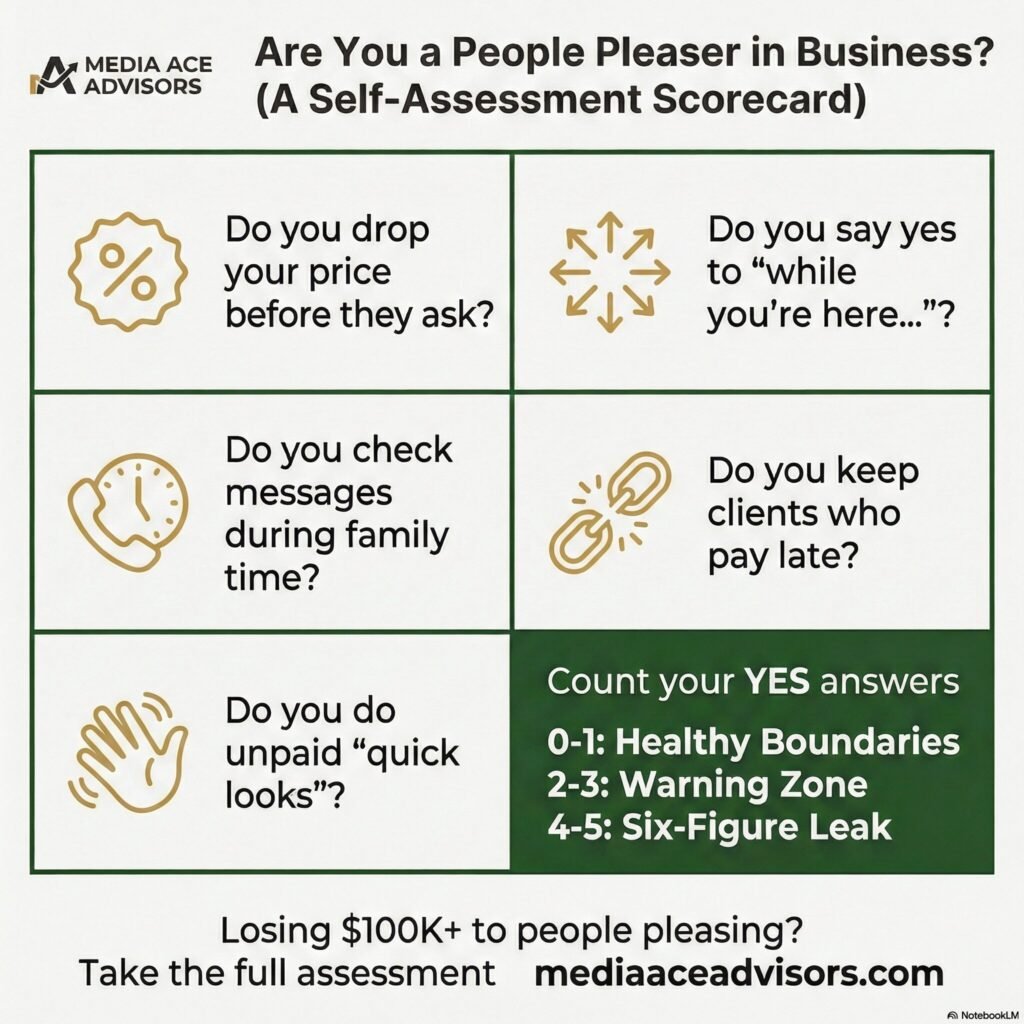
You’re experiencing people-pleasing profit leak if you recognize any of these patterns in your business: giving discounts before clients ask, saying yes to projects outside your expertise, responding to client messages during family time, or keeping clients who pay late and demand constant availability.
Let’s make this concrete with real numbers. If you’re a service business doing $750K annually with 10% net profit ($75K), people-pleasing behavior typically costs you:
| People-Pleasing Behavior | Estimated Annual Profit Leak | Impact on Business Growth |
| Underpricing / Giving Discounts | $35,000 – $70,000 | Erodes pricing power and devalues your brand in the market |
| Unbilled Scope Creep | $75,000 – $110,000 | Consumes capacity that could serve high-value clients |
| Maintaining Wrong-Fit Clients | $25,000+ (Indirect) | Increases staff turnover and drains team morale |
| Business Scalability | Indeterminable (Growth Stalls) | Founder becomes the bottleneck; business value remains at 1.5x multiple instead of 3x-4x |
| Total Opportunity Cost | $135,000 – $205,000 | Prevents scaling past the $500K revenue ceiling |
Here’s what most business owners miss: people-pleasing behavior fundamentally breaks your unit economics. When you accept scope creep, your Cost of Goods Sold (COGS) increases while revenue remains stagnant, effectively killing your Gross Margin before you even pay your overhead. You’re working harder, delivering more, and making less. The math doesn’t work, but you keep saying yes because it feels like good customer service.
Beyond dollars, there’s the personal toll. In my interviews with business owners, I consistently hear about 70-hour work weeks, inability to take vacations, missing family time, experiencing chronic stress – all while serving clients who don’t appreciate them and wouldn’t pay their full rate. The people pleasing creates a prison disguised as customer service.
The compounding problem is that people pleasers attract more difficult clients because word spreads that you’ll say yes. Your best clients (who respect boundaries and pay well) see you’re overextended and look elsewhere. Meanwhile, your worst clients refer their friends who also expect favors and discounts. You’re unknowingly building a client base optimized for low profit and high stress.
Beyond the immediate math, people pleasing destroys your Lifetime Value (LTV) metrics. You aren’t “retaining” clients – you’re “collecting” liabilities. True client retention is built on a repeatable process that creates mutual value, not on the founder’s personal heroics and constant availability.
Research from pricing psychology experts shows that businesses with clear pricing boundaries maintain 20-30% higher margins than those who negotiate on every deal. Your boundaries aren’t just about saying no – they’re about protecting your ability to say yes to the right opportunities.
The Five Types of Business People Pleasing
Type 1: The “Just This Once” Person
Says yes to one-off requests that become recurring expectations. “Can you just take a quick look?” turns into 30 unpaid hours annually per client.
In HVAC businesses, this looks like free “diagnostic visits” that turn into full system evaluations without proper quoting or compensation. What starts as “let me just check your system real quick” becomes a 90-minute troubleshooting session you never billed for.
Type 2: The Discount Dealer
Drops price before clients even ask. “I’ll work with you on price” becomes the standard offer. Leaves 10-15% on table because asking for full price feels uncomfortable.
In consulting practices, this sounds like “let me work with you on price” offered before the client even pushes back on your proposal. You’ve already negotiated against yourself before the conversation started.
Type 3: The Scope Creep Accepter
Agrees to project additions without change orders. “While you’re here, can you also…” becomes $5K of extra work for free. Can’t say no because client “might get upset.”
In construction and remodeling, this manifests as “while you’re here, can you also fix this unrelated issue?” accepted without revised contracts or additional billing. The original $10K project becomes $15K in actual work for the same price.
Type 4: The All-Hours Available
Responds to texts at 9 PM, takes calls during family dinner, works weekends because clients “might need something.” No boundaries between work and life. Secretly resents clients but won’t set limits.
In professional services, this appears as checking client messages during dinner, weekends, and vacations because “what if they need something urgent?” Your phone is never off, and your family knows they come second.
Type 5: The Bad Client Keeper
Maintains relationships with late-paying, high-maintenance, low-value clients out of fear. “What if they leave a bad review?” or “What if they tell people I’m difficult?” Better to lose money than risk disapproval.
Across all industries, this is keeping the client who pays 60 days late, demands immediate responses, and generates half the profit of your average customer. You know you should fire them, but you’re afraid of what happens if you do.
Which Type Are You?
Count how many of these statements are true for your business:
- I’ve given a discount this month without the client asking
- I’ve worked more than 5 hours unpaid on client projects in the past 30 days
- I have at least one client who pays late or demands constant availability
- I’ve said yes to a project I knew was outside my sweet spot this quarter
- I check client messages during family time more than twice weekly
Your Score:
- 0-1 statements true: Healthy boundaries in place
- 2-3 statements true: Warning zone – profit leaks starting
- 4-5 statements true: Six-figure profit leak – immediate action needed
The Profitable Boundaries Framework™
Good clients WANT you to have boundaries. They respect businesses that are clear about scope, pricing, and availability. The only clients who resist boundaries are the ones you should lose. This isn’t just about “saying no” – it’s aboutStrategic Capacity Management.
The transformation from people pleaser to strategic business operator doesn’t happen by learning to say no more often. It happens by becoming the kind of person who values their capacity as a finite, precious resource. You’re not rationing your time. You’re investing it strategically.
The Profitable Boundaries Framework™ has three parts:
Part 1: The Qualification Filter
Not every inquiry deserves a yes. Before accepting new work, ask yourself three questions: Does this align with my core expertise? Can I deliver exceptional value at a profitable price point? Will this client respect my process and boundaries?
If the answer is no to any question, decline gracefully. “I don’t think I’m the best fit for this project, but I’d be happy to refer you to someone who specializes in this area.” You’re protecting your capacity for ideal clients while still being helpful.
This is identity work. You’re becoming the kind of business owner who makes strategic decisions based on fit, not fear. The filter doesn’t make you selective – it makes you strategic.
Part 2: The 24-Hour Rule
Never say yes on the spot to scope changes, rush requests, or pricing negotiations. “Let me check my schedule and capacity, and I’ll get back to you by tomorrow” gives you space to evaluate whether this serves your business strategy.
This single rule eliminates 80% of people-pleasing decisions. The pressure to respond immediately triggers your survival instinct to say yes. Twenty-four hours gives you time to think strategically instead of reactively.
Part 3: The Clear Offer
When you do say yes, be explicit about what’s included and what’s not. “This proposal covers X, Y, and Z. Anything beyond that scope would require a separate agreement with adjusted pricing and timeline.” Clarity prevents scope creep before it starts.
Good clients appreciate clarity. Difficult clients resist it. That resistance is valuable data about whether you should work together at all. Learn more about bundled pricing strategies that make scope boundaries explicit.
Start Tomorrow
Before you check email tomorrow morning, do this exercise: Write down the last three times you said yes when you should have said no. Next to each, write the dollar cost (in time, scope, or underpricing). That number is your motivation for implementing the Profitable Boundaries Framework™ starting today.
Your “no” actually makes your “yes” more valuable. When you say yes to everything, your yes means nothing. When you have clear boundaries, clients know that working with you is a privilege, not a right. That’s not arrogance. That’s positioning yourself as the specialized professional you’ve become.
Stop Leaving Six Figures on the Table
You’ve spent years building a reputation as the business everyone can count on. But if being counted on means working 70 hours, missing family time, and earning less than your employees, something’s fundamentally broken. The good news? This isn’t a personality flaw you need years of therapy to fix. It’s a business behavior you can change with strategy.
The business owners who thrive aren’t the ones who say yes to everything. They’re the ones who say yes to the right things and no to everything else. That’s not being difficult. That’s being strategic. And strategy creates profit.
In 2026, with labor costs higher than ever and client expectations constantly increasing, profit margins matter more than they ever have. You can’t subsidize your clients’ businesses with your own profit and expect to build something sustainable. Every yes to a bad-fit client is a no to your own growth, your team’s stability, and your family’s financial security.
Here’s what nobody talks about: a business built on the owner’s inability to say no is an unsellable business. No investor or buyer wants a company where the profit is tied to the founder’s personal people-pleasing patterns. According to small business valuation data, businesses with founder-dependent operations sell at 1.5x-2x EBITDA multiples, while systematized businesses command 3x-5x multiples. Implementing the Profitable Boundaries Framework™ isn’t just about this month’s cash flow. It’s about building an asset that can eventually run without you, that has real value beyond your personal availability.
The transformation starts with a decision about who you’re becoming. Not what you’re doing differently, but who you’re choosing to be. Are you becoming the kind of business owner who protects their capacity? Who values their time? Who builds something that serves your life instead of consuming it?
The Pathway to Profit Diagnostic
I’m currently interviewing service business owners for the second edition of my book on profit strategies. During these 45-minute conversations, I analyze your entire profit picture across all seven profit levers – including where people-pleasing behavior might be costing you.
This isn’t a sales pitch. I share the complete Pathway to Profit framework, we walk through your numbers, and I show you specific opportunities I observe in your business. You’ll leave with clarity on which profit levers have the biggest opportunity for your specific situation.
Here’s what I’ve learned: the business owners who actually implement these changes and see results are the ones who are decisive and action-takers. They’re all in on becoming a different kind of business owner. They can’t go another day operating like this. If that’s you – if you’re ready to stop being a passenger in your own business and start being the strategic operator you’re capable of becoming – then this conversation will be valuable.
But if you’re not sure, if you need to think about it, if you’re comfortable enough with how things are – that’s okay too. I only work with business owners who are ready for transformation, not transaction. The people who succeed with this aren’t looking for more tactics to add to their to-do list. They’re looking to become someone different.
There’s no cost, no obligation, just a strategic conversation about profit. These conversations typically reveal $50K-$150K in profit opportunities through the Profitable Boundaries Framework™ and the other six profit levers.
If you’d like to be interviewed and receive a complimentary copy of the book when published, schedule here: [BOOK INTERVIEW LINK]
45 minutes of your time. Seven profit levers assessed. Clear roadmap to six-figure profit improvements. Zero sales pressure. You’ll see exactly where your profit is leaking and the dollar value of fixing each leak.
Every month you operate with people-pleasing behaviors costs your business an average of $8K-$12K in lost profit. That’s $100K+ annually. The cost of staying the same compounds, while the cost of change is a 45-minute conversation and a decision about who you’re becoming.
About the Author:
I’m Ryan Herrst with Media Ace Advisors. I’m a Certified Profit Advisor and published author of Profit Foundation, currently working on the second edition based on 100+ interviews with service business owners. I recently led a conference workshop on profit optimization strategies for owner-operated businesses.
While the Profitable Boundaries Framework™ is used by clients nationally, its development was rooted in my work with the small business community in Lansing, Michigan, observing the unique pressures of Midwest service providers who built thriving businesses on hard work and integrity but struggled to translate that into sustainable profit.
I help service business owners earning $250K-$5M annually (with 10 or fewer employees) identify hidden profit opportunities and create clear pathways to growth. My approach focuses on systematic improvements across all seven profit levers, with special expertise in conversion optimization and the Profitable Boundaries Framework™ that helps business owners reclaim 10-15 hours weekly while improving margins.
If you recognize the people-pleasing patterns in this article, I’d be honored to interview you for my book and show you exactly where your six-figure profit opportunities are hiding.